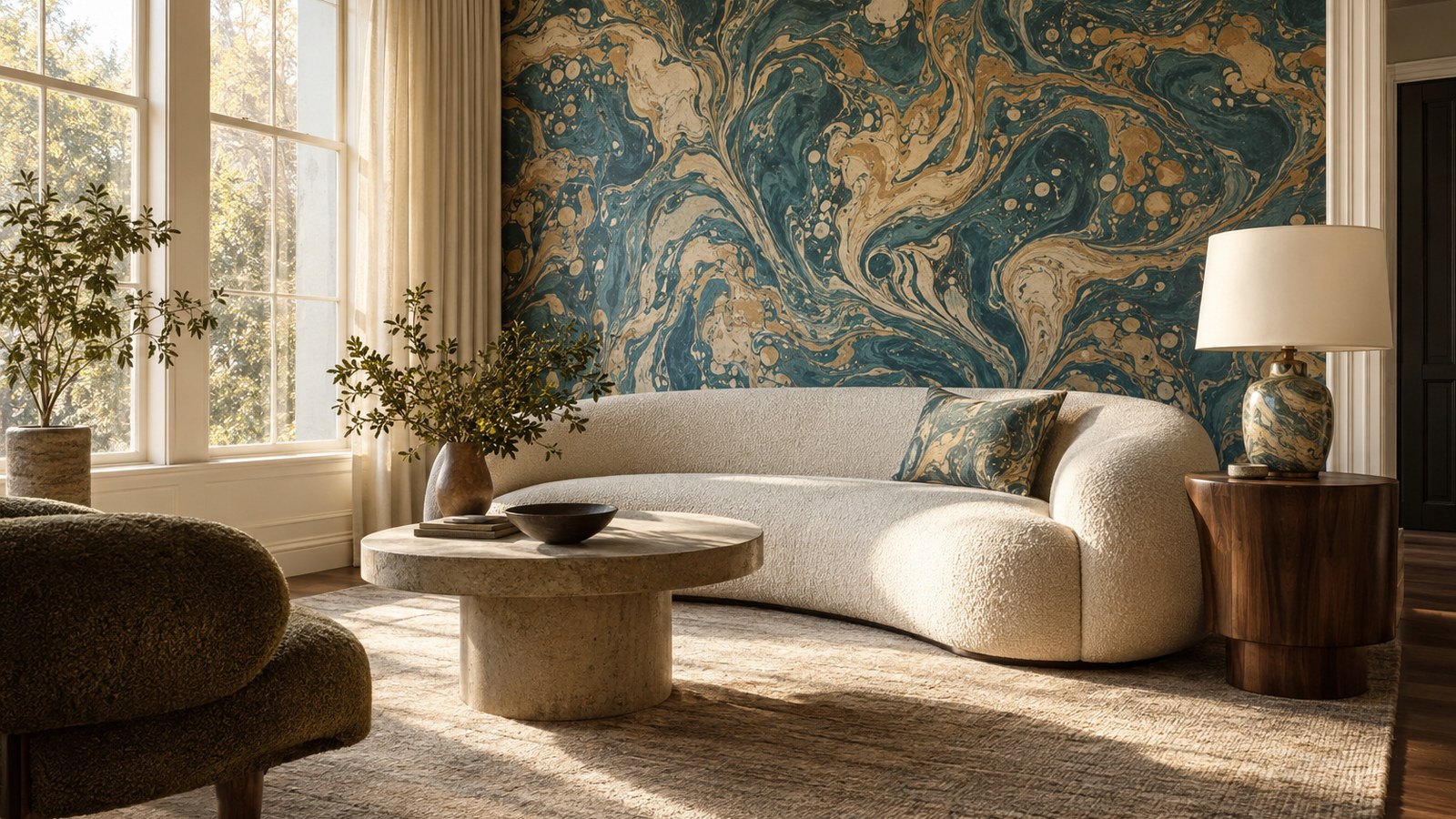
After years of greige, plenty of homeowners are bored with walls that play it safe. Many designers are reaching for a pattern whose roots go back more than a thousand years. Marbling is the swirly look with deep ties to old-world bookbinding, and it’s now turning up on walls, lampshades, chairs, rugs, and even sink skirts.
- Designers say marbling brings movement and a handmade feel that flat neutral walls can’t match.
- The look has moved well past paper, into murals, resin chairs, silk fabric, and lampshades.
- Small pieces like a marbled lampshade let you try the trend before you cover a whole wall.
An Old Technique With New Fans
In 10th century Japan, artisans made “floating ink” designs by steering ink on water. By the 15th century it was known in Turkey as the art of clouds, and from there it reached bookbinders in Venice and Florence.
With AI showing up everywhere, designers are leaning on heritage looks to make rooms feel personal. New York designer Cara Woodhouse says her clients want surfaces with real character, and marbling comes with an artisan backstory. Depending on the colors, it can look painterly, graphic, or soft.
Designer Sasha Bikoff notes that marbling doesn’t have to look traditional, or even be on paper. She loves how color moves in organic, unpredictable shapes, a quality that suits furniture, textiles, and decorative objects too.
Walls That Look More Like Art
Woodhouse describes marbling as pattern without repetition. Since no two passes come out the same, a marbled wall looks more like a painting than wallpaper, adding depth to a room that might otherwise seem too polished.
Michelle Fahmy of Haus of Meeshie wanted drama for a Culver City pied-à-terre stairwell that greets you at the front door. She chose a large Mitchell Black mural of groovy swirls. Since marbling usually shows up on fabric or small items, the sheer scale made it a built-in conversation starter.
Bikoff took a looser approach in a Zaha Hadid building, picking a Pierre Frey wallpaper with a liquid, dripping marble effect instead of a classic swirl. The flowing lines make the walls look like they’re melting, playing off Hadid’s organic architecture. She wanted the room to feel like stepping inside abstract art.
In a bathroom by Braswell Design + Build, designer Marta St. Amour let the Lee Jofa Taplow wallpaper set the color story. Its amber, soft blue, and sandy beige tones tied together Taj Mahal quartzite, caramel shower tile, and soft blue tile behind a sculptural freestanding tub. If you’re stuck on a palette, pull your colors straight from a marbled pattern you love.
Marbling Moves Off the Wall
You don’t need wallpaper to get the look. In a dining area, Bikoff used resin chairs swirling with marbled color. She compares the effect to liquid frozen in time, making the chairs feel like functional sculptures.
Fabric works too. Analisse Taft-Gersten, cofounder of the 1818 Collective, dressed a powder room sink in a silk skirt of Rule of Three fabric that looks almost bubbly. Its print has rhythm but enough irregularity to keep the eye moving, echoing the round pebble mirrors above. Rule of Three also makes marbled florals that look like winding vines.
Lampshades might be the easiest way in. Pooky is known for its hand-marbled shades of swirling acrylic paint. Jo Plant, the brand’s chief creative officer, says people crave texture, character, and handmade pieces over mass-produced ones. A single shade adds a dose of maximalism without taking over a room.
Thinking About Color and Scale
Marbling can look loud, but Austin designer Killy Scheer argues it works as a surprisingly flexible neutral that layers well with other textures, patterns, and artwork and adds depth without overwhelming a space. Scheer spotted a surge of marbled repeats heading into 2026.
For a girl’s bedroom, Woodhouse chose the cotton candy toned Merenda Wallpaper by artist Michelle Weinberg, aiming for movement more than sweetness. The blush swirls give the walls energy without any literal motif, so the furniture can stay simple.
Start With One Swirl and Build From There
If beige walls feel flat, marbling adds color, depth, and a sense of handwork. Try a lampshade, a pillow, or a fabric skirt first. When you’re ready for more, an accent wall, powder room, or stairwell suits a full marbled pattern. Pick a colorway that fits your mood, keep the furniture simple, and let the swirls carry the room.
